Evolution – A Review of the BBC Series – Part 2
Over the summer of 2026, the BBC released a much publicised series called Evolution presented by Chris Packham. This multi-part in-depth review of the BBC series has been prepared for CViE by a secondary school Head of Science.
This is Part 2 which looks at some examples of poor science in the series.
Part 1 provided an introduction to the review, an overview of the series and general reflections on it from a Christian perspective – read Part 1 here.
Some Specific Examples of Poor Science
Rigorous scientific content is lacking throughout the series. The scientific method involves making hypotheses and testing them against observable evidence. Hypotheses which are consistently supported by such evidence become established as scientific fact. In Evolution this process is flipped on its head, with the little evidence which is provided (e.g. the fossil records and DNA sequencing) being used to point back to pre-existing conclusions. There is certainty no attempt made to consider alternative interpretations. The conclusion is the philosophical premise of the series – evolution happened so the evidence must point back to that and be interpreted only in that light.
In this section I aim to set out, as simply as I can, some examples of the presented ‘evidence’ and the problems with it from both a scientific and Biblical perspective. I want to make clear at the outset that I am not an expert in the field of evolutionary biology and this is not intended to be a detailed critique, rather a high-level overview of some key difficulties. Please forgive me if at any point I make any errors or oversimplifications of the science involved.
The Last Universal Common Ancestor (LUCA)
Evolutionists believe that all life on earth today evolved from a single common ancestor, which they have named LUCA – the Last Universal Common Ancestor, or the organism back to which all other organisms can trace their evolutionary heritage. In Evolution Packham presents LUCA as a factual organism, implying that it provides evidence for evolution.
“The cells in here are amongst the most complex things in the known universe. Each one of these cells is generating energy, distributing that energy, dealing with waste. It’s sensitive to its environment. It’s reproducing. Every one of these cells is more complex than any machine ever made by any human. Just like these cells, LUCA was complex, robust, resilient, which may have helped it cling on against the odds.”
In reality, if evolution is true and all organisms have formed over millions of years through minute changes generation-on-generation, then they must by definition be traceable back to a single universal ancestor. By this measure, LUCA should be presented as an theoretical organism necessarily required by the theory of evolution, not as a factual starting point from which everything else arose.
Shared structural morphology as proof of a common ancestor
In “The Evidence” section at the end of Episode 1, various scientists are shown explaining how using ‘comparative anatomy’ (looking at the similarities and differences between species found in the fossil record and those alive today today), “scientists would look at what animals had in common, or didn’t have in common, to try to recreate their evolutionary relationships.” One scientist in this section freely admits, “one thing we have to bear in mind is that when we’re looking at fossils we’re looking at the remains, what was left behind, and it’s not always complete. So, it’s like trying to reconstruct a hand from a finger print… and we made lots of mistakes.” In spite of this admission, the series goes on to assert comparative anatomy as evidence for common ancestry, and by implication evolution, on several occasions.
For example, in Episode 2, where amphibians are introduced as the first land animals, Packham uses the following argument:
“Now, I’m about to show you something which is remarkable, astonishing even, and I think very beautiful. Take a look at this. This is a drawing of the bones in the foot of one of those ancient amphibians. It lived over 300 million years ago, but look at it – does it look familiar? It should do [at this point the image shows the human hand next to the drawing], that’s because these ancient amphibians were our ancestors. Not only our ancestors, but the ancestors of all the animals with backbones that have ever lived or are living on land today.”
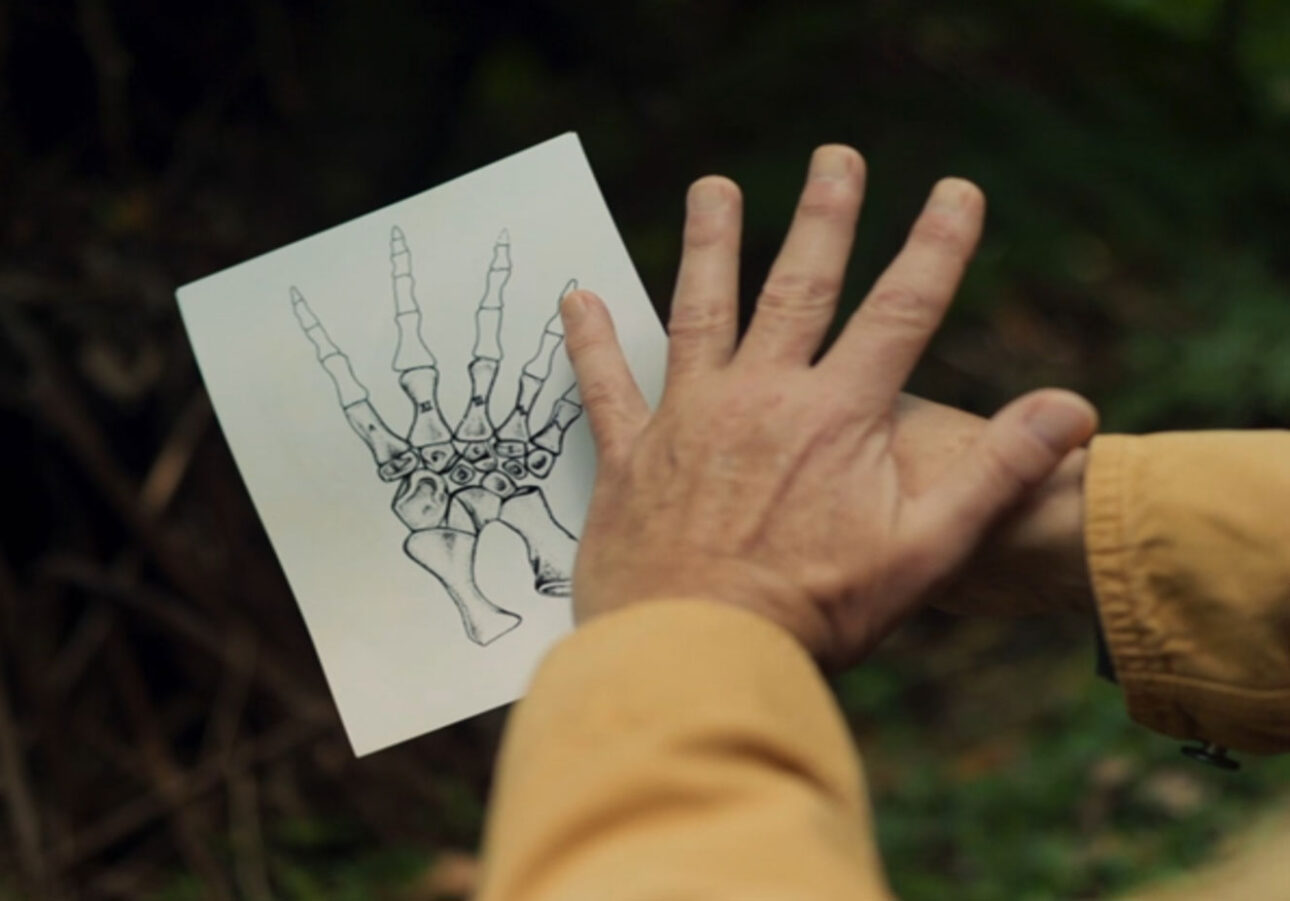
Packham states as fact that, because the drawing of the bones in this “ancient amphibian” – presumably constructed from incomplete fossil fragments (given that no image of any actual fossil is shown) – looks similar to the bone structure in a human hand, then that must be because we are descended from these amphibians. The possibility that similarity in design might be due to a common designer is not even considered.
Shared DNA as proof of a common ancestor
Throughout the series, but particularly in discussing LUCA in Episode 1, Packham asserts that, “because all living things have DNA and use the same genetic code, we know there must be a shared origin.” DNA holds the genetic code in almost every cell of every organism; it is essentially the instruction book for life. Different organisms have different patterns of genetic code in their DNA and Packham is essentially making two arguments:
- Because the genetic instructions in all organisms use the same basic code (a bit like an alphabet), they must all have arisen from a common ancestor.
- Because there are significant overlaps between the patterns of genetic codes across many different organisms, this too points back to a common ancestor. (In reality this second argument is much more complex and involves phylogenetic analysis which maps DNA similarity across different organisms and uses this to interpret how closely related they are, ultimately leading to the ‘tree of life’ idea, with LUCA at the root – a major flaw in this method from a scientific perspective is that it presupposes that LUCA must exist).
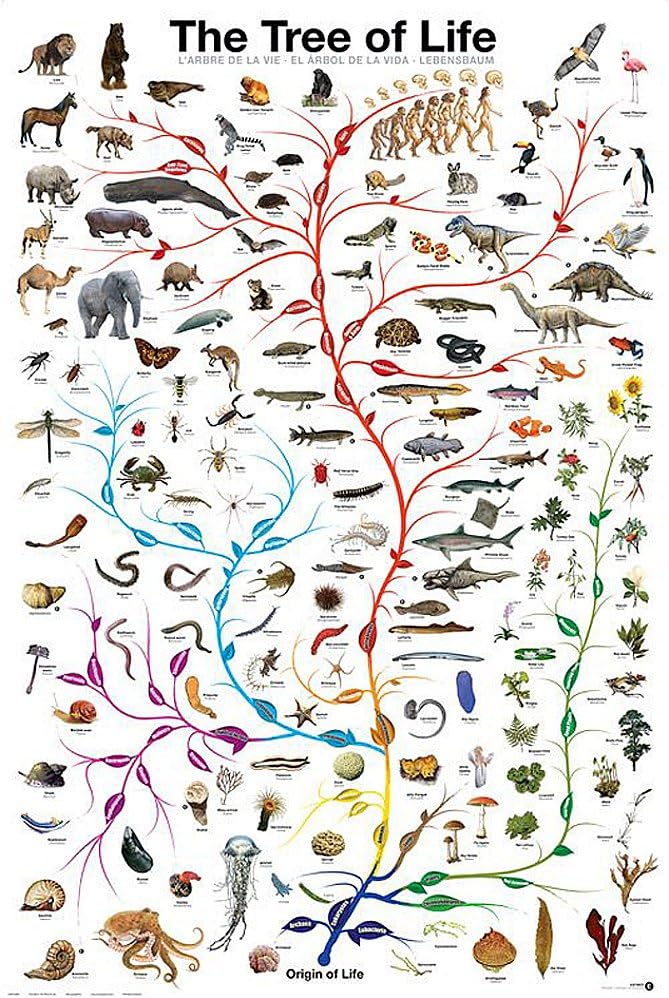
From a long-age evolutionary worldview perspective, these arguments make sense. However, they are not conclusions which flow directly from the observable evidence, they are one interpretation of the evidence when seen through the lens of a universe without God. If we view these same observations through the lens of Biblical truth, we conclude that all organisms use the same genetic code because they were designed and made by the same designer: They do not need to have evolved from a common ancestor.
It’s important to recognise that we can’t use this as firm proof of a creator God, but think back to the complexity inside even a single cell and ask whether God or blind chance is the most likely explanation?
The fossil record as proof of evolution
The fossil record makes for fascinating study and we can learn much about extinct species and global conditions in the past from studying it – many observations from the fossil record are consistent with a catastrophic global flood such as we read about in the Bible in Noah’s day (for more on this see this article from Answers in Genesis). I want to be clear from the outset that when we look at fossils of species which we no longer see on earth today, these are real evidence of real organisms – dinosaur fossils are proof that dinosaurs walked the earth. Trilobite fossils reveal a panoply of strange creatures unlike anything we see on earth today. But these fascinating snapshots of extinct organisms do not provide evidence for evolution. So, what claims does Evolution make and why are these incorrect?
Fossils are shown throughout Evolution, usually as the basis for VFX footage bringing to life organisms which are no longer alive today, but which evolutionists believe to be steps on the evolutionary journey from LUCA to the organisms we do observe directly. Assertions are made picking out features from these fossils and linking them directly to features observed in current-day organisms. For example, in Episode 2 about the Ostrich, fossils of lobed-finned fishes are linked to the emergence of amphibians from fish, which in turn are described as undergoing transformations to grow legs, breath outside of water, lay eggs with hard shells and an amniotic sac, produce feathers and grow wings, with occasional fossils picked out to illustrate how these changes progressed. All assertions of this progression of organisms through the fossil record are expressed with great certainty. For example, after showing the fossils of Pseudocrypturus and Calciavis (winged but flightless dinosaurs), Packham narrates, these were “big and heavy, and better adapted to life on the ground” then goes on to describe “one of their descendents”, the common ostrich “our largest bird … with sturdy bones which they inherited from lobed finned fishes, and I can see that those legs are covered in scales, so are their toes – signs of their reptilian ancestry.”
Another aspect of the fossil record which the series makes no attempt to explain is how fossils are dated. Ages of millions, even billions, of years are asserted throughout as undisputed fact. For example, in Episode 2 Packham states,
“When the first fossil feather was found, scientists were struck by its similarity to the feathers of modern birds, but this feather is 150 million years old, placing it firmly in the era of the dinosaurs.”
He makes no mention of how this 150 million year old date has been established, either for the feather fossil, or for dinosaurs. In contrast to the implied surprise of evolutionary biologists, as Bible believing Christians, it is no surprise that a fossil feather looks identical to feathers we see today – God created feathers in their current form when he created birds on the fifth day of creation. You can read more about fossil dating methods here.
Lastly, with regard to the fossil record, at the end of Episode 5 a small hint is given of the level of imagination involved in telling the ‘Evolution‘ story. In “The Evidence” section, one scientist says,
“when we think about a book, you have a lot of different pages that tell us the story from start to finish. However, with evolution and fossils, some of those pages are missing.”
This is an implicit admission that the evidence for evolution is, at best, incomplete, but it really doesn’t state the truth of the matter. Rather than being like a book with a few pages missing in which we might reasonably be able to fill in the gaps, the fossil record is like the works of Shakespeare with only a handful of pages present. The vast majority of ‘prehistoric’ creatures, asserted as factual stages on the evolutionary pathway to modern-day organisms, are completely imagined. The evidence for them is nonexistent. Sometimes fossils are found which are claimed as ‘intermediates’ or ‘missing links’ but there is no real evidence that this is what they are. You can read about some of them from a creationist perspective here (Tiktaalik, an example specifically mentioned as transitional in Evolution) and here.
Rather than assuming that the fossil record is so incomplete that millions of years of history are lost, how much more sense it makes to believe that God created all the species which have ever existed e(ither today or in the past) and that, due to the fall and the flood leading to environmental changes, disease etc., some of these have become extinct and so are only observable in the fossil record.
Ignoring the challenge of irreducible complexity
The final point I want to highlight with regard to the questionable science in the series is the lack of any mention of the challenge of irreducible complexity gives to evolution.
The theory of evolution is based on the premise that small random mutations in DNA lead to small changes in physical or behavioural characteristics of organisms from generation to generation. If a particular random mutation confers a survival advantage on a particular organism within a species, then that organism is more likely to survive and reproduce than an organism which does not have this mutation. Thus, over time, the advantageous trait becomes more prevalent within a population. This process is known as natural selection and is an observable phenomenon in the natural world today.
The theory of evolution, as described in the Evolution series, takes this many steps further by stating that over many generations and long time periods, these mutations have led to all the gradual changes which turned LUCA into every organism which lives today and indeed has ever lived. What the theory fails to recognise is that, although it might be possible to imagine how a new feature could incrementally develop over many generations, unless there is a clear survival advantage at every stage of the process this simply would not happen – and in countless examples it is impossible to identify this advantage. Furthermore, many complex organs which we observe today would have required multiple simultaneous mutations to converge in the same place at the same time, as, taking away just one component from the mechanism (of, say, the eye) renders it useless. To give a simple analogy, a three legged stool requires three legs and a seat to function as a stool. Remove one leg or the seat and you no longer have a functioning stool – it is irreducibly complex. The theory of evolution has no coherent explanation for how such systems could arise by chance and the series Evolution certainly makes no attempt to acknowledge this, let alone explain it.
I will mention three examples from Episode 3 of Evolution.
Firstly, five minutes is devoted to describing the changes leading from gills to jaws, starting with an organism found in the fossil record: Metaspriggina, a filter feeding fish-like organism whose fossils indicate prominent gill arches, “structures which support gills… as it swims, a constant stream of water flows into the fish’s open mouth. This is how Metaspriggina breathes, passing water over its gills supported by those gill arches.”
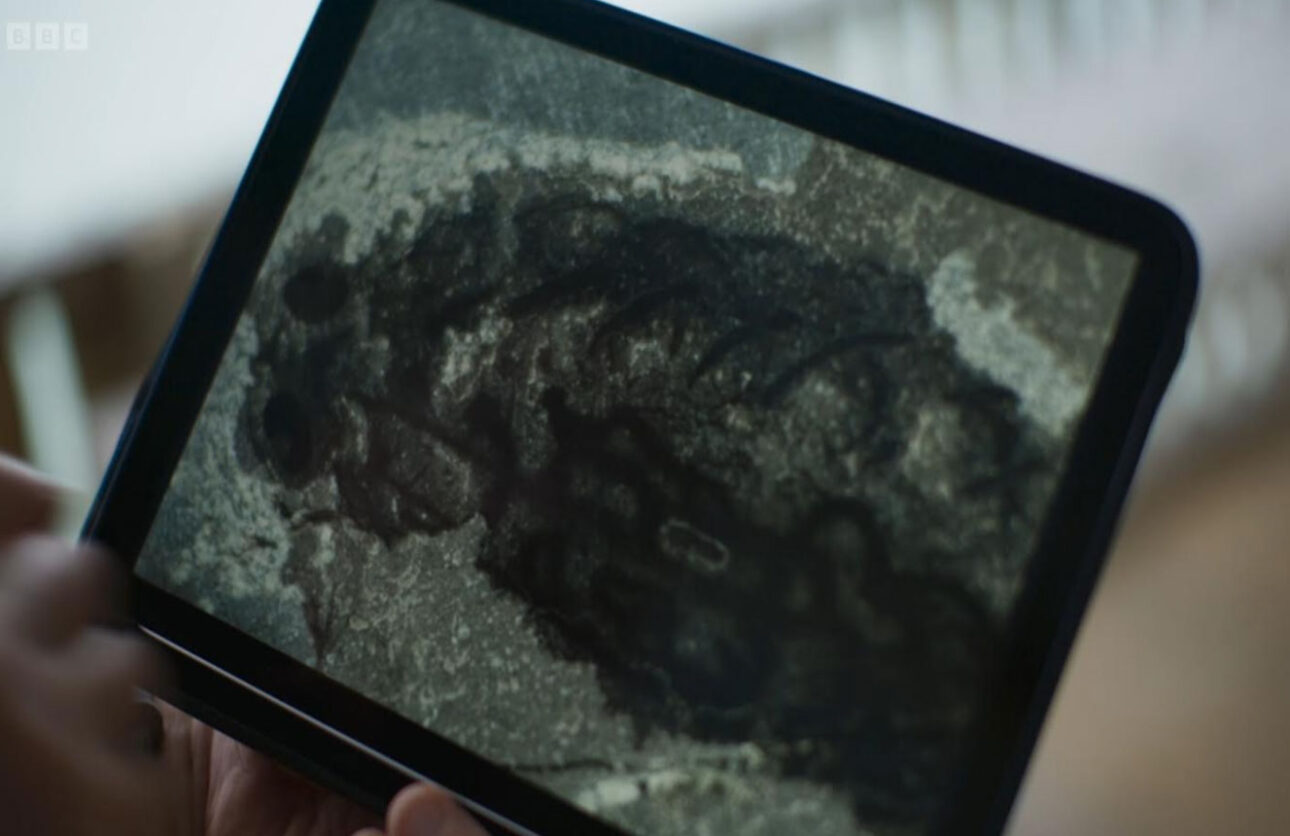
Packham goes on to describe how these gill arches became jaws (numbers indicate the stills in the table below taken from these points in the narration):
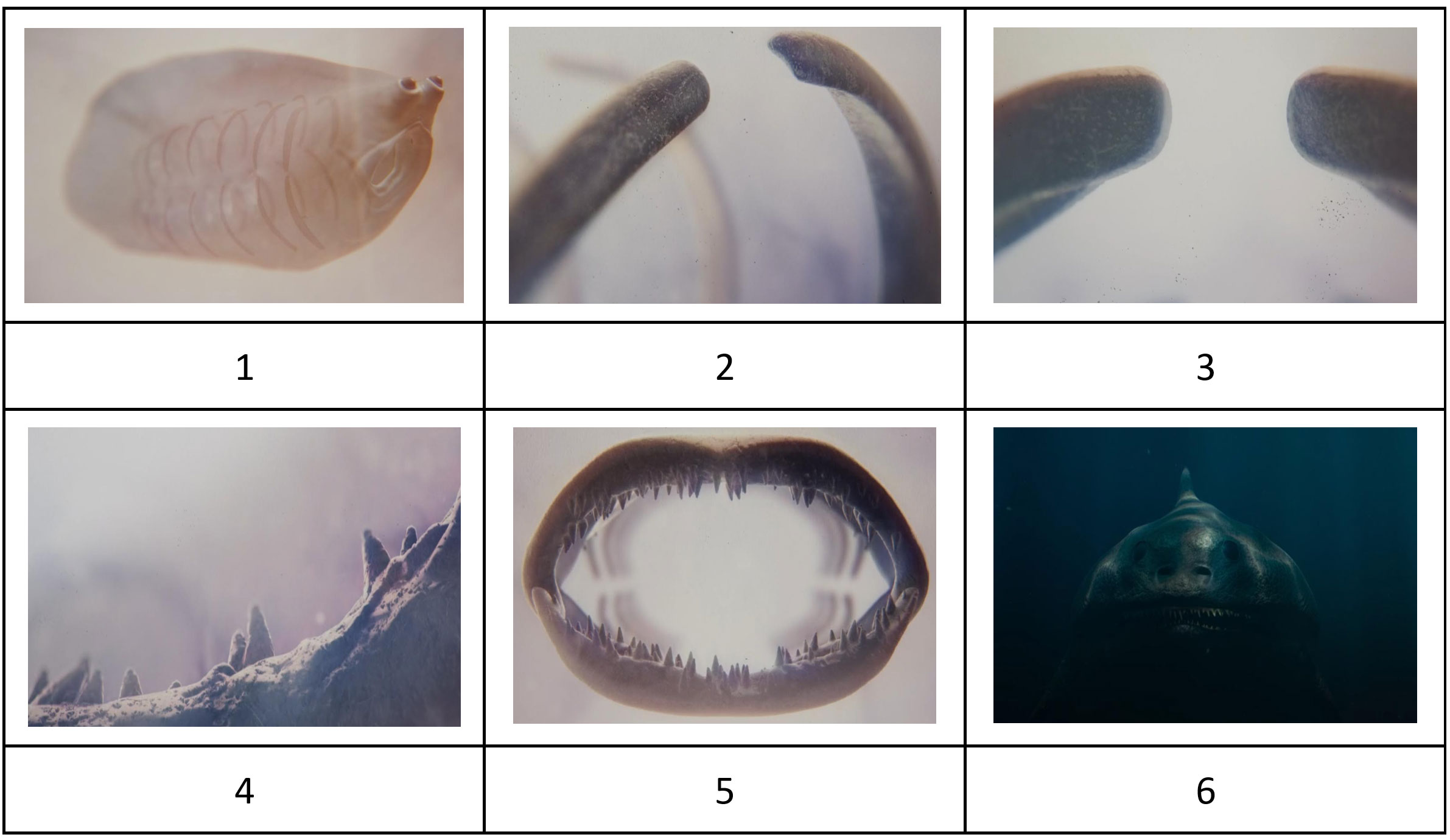
“Scientists have found that Metaspriggina’s front gill arches are actually thicker and appear to lack oxygen absorbing gill filaments, a tantalising hint that they might have jettisonned their old role for a new one – keeping the fish’s gaping mouth wide open” to enable filter feeding. “Because thick gill arches lead to a wider mouth, more food and oxygen, and more energy to escape [from predators], it’s an advantage that’s passed on (1). Across countless generations the gill arches continue to thicken and strengthen (2,3), new structures erupt (4), and after tens of millions of years what was once a gill arch becomes a revolutionary new body part (5) which means this fish can bite (6)!”
It might be reasonable to suggest that thicker gill arches which hold open Metaspriggina’s mouth more effectively, enabling it to obtain more food and and oxygen is a trait which could be passed on to the next generation, but to jump from this to the lengthening and fusing of these arches into the jaw bone, and then the eruption of teeth over tens of millions of years to form a jaw goes well beyond the reasonable. And there is a complete failure to mention the complex joints and muscular structure which would be required to enable that jaw to operate, or the changes in the digestive system to enable the digestion of the very different diet which would be consumed. All of which would have to have happened simultaneously and with clear survival advantages at every stage in the process to ensure that the changes kept being passed on. The jaw is irreducibly complex. It is a hallmark of God’s incredible design which could not reasonably have been made by incremental steps of blind chance.
Later in Episode 3, Packham goes on to describe various changes purported to have taken place within the jaws of mammals as they evolved to chew food,
“over generations, a lower jaw made of several bones is gradually reconfigured. One bone gets larger, whilst the others shrink until a single powerful lower jaw evolves. The old jaw bones wither away, but not all are lost. These are the remnants of those jaw bones, they’re called the malleus and the inca (hammer and anvil), they’re two of the smallest bones in our body and they’re disconnected from the rest of our skeleton. The key thing is, when we were in the womb, they started off as part of our jaw where they migrated up to our ear where they are joined by this bone. This one is called the stapes (stirrup) and together they connect our ear drum to our inner ear, greatly enhancing our capacity to hear. Particularly a wider range of frequencies.”
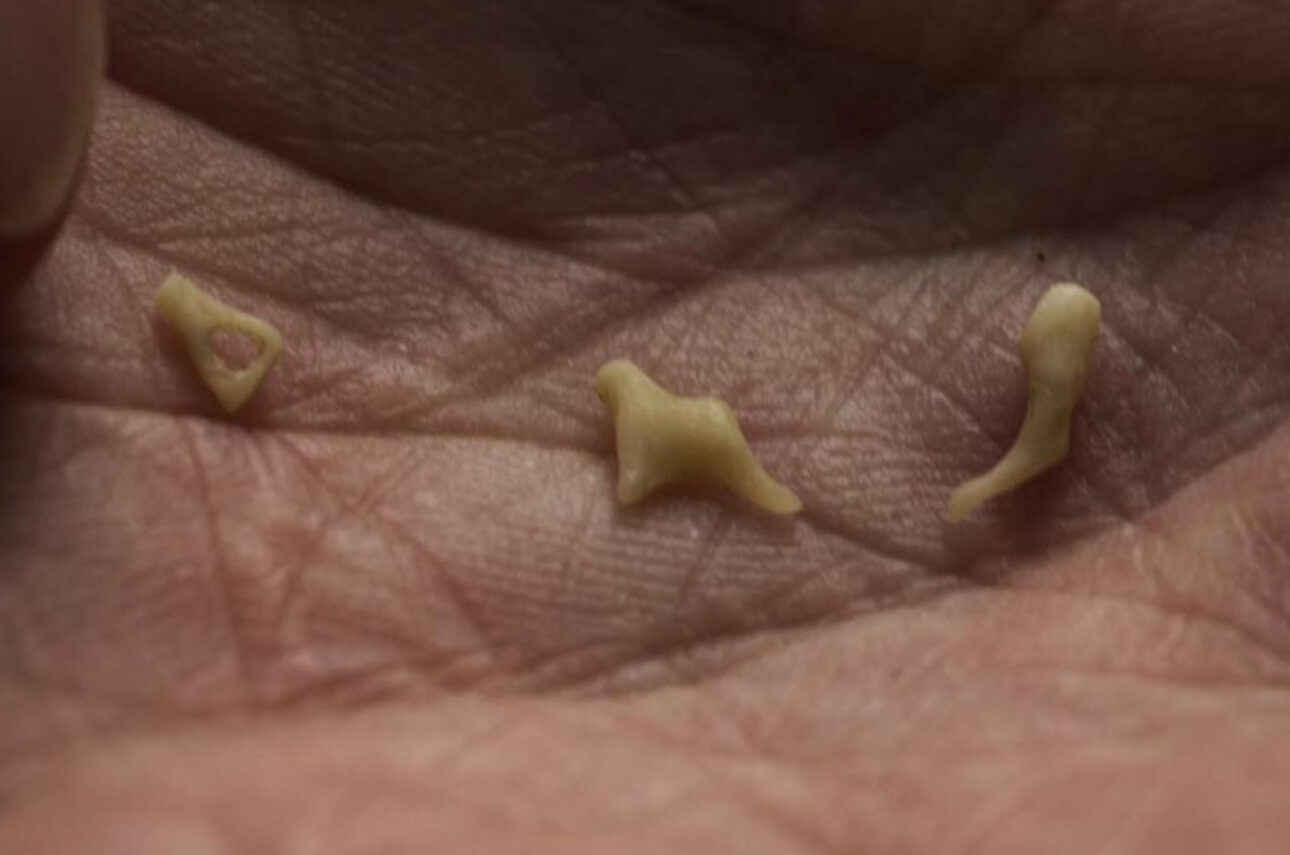
“The evolution of the inner ear bones transformed hearing for many mammals … today, mammals have some of the most sensitive hearing of all animals. It’s remarkable to think that over 400 million years ago, these bones were part of an ancient fish’s gill arches. This is the power of evolution right here in the palm of my hand. No designer was involved in making these bones which are currently floating in your head allowing you to hear what I’m saying. All that was needed was life’s relentless drive to find food. That, and quite a bit of time.”
There is really little need to comment further on these statements – which are essentially assertions of the evolution of irreducibly complex systems as undisputed fact, coupled with the blunt denial of the possibility of a designer.
Finally, Packham goes on to describe the evolution of echolocation in bats.
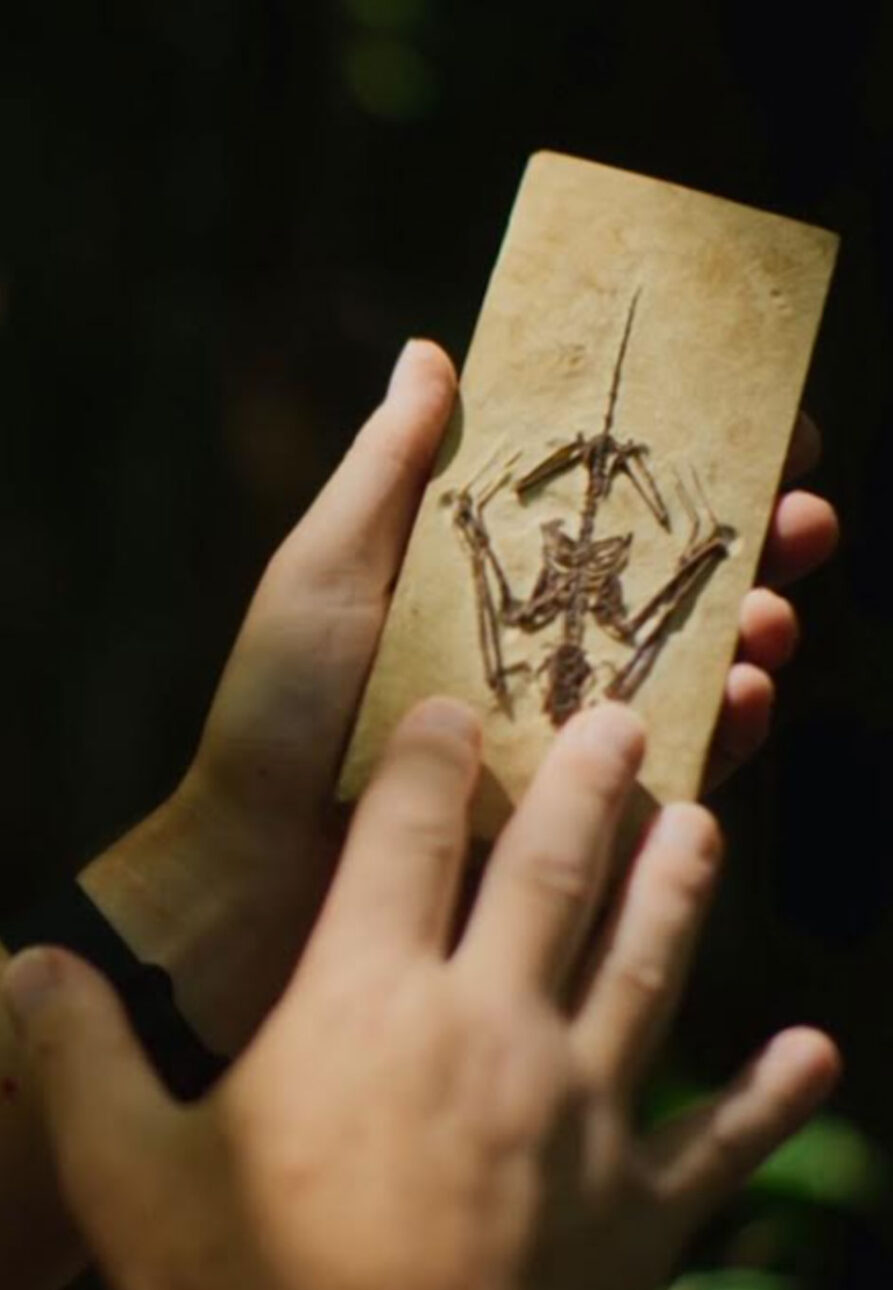
“Among them [mammals], a remarkable new group that would use their acute mammalian hearing in a truly innovative way. This is a replica fossil of an approximately 52 million year old creature called Icaronycteris … this is the fossil of a bat. Now there’s a lot more we need to learn about the evolution of bats, there’s a big gap between that period when the asteroid hit and this, 14 million years later … Scientists have X-rayed this skull and they’ve found that inside the inner ear it has an enlarged cochlea and that, alongside the fact that it had ossicles, might suggest that this creature could echolocate. How about that! Quite when creatures like this started to echolocate we’re not sure …”
Here Packham clearly acknowledges a 14 million year gap in the fossil record and that evolutionary scientists have no idea how this (or a bat’s ability to fly) came about, but he asserts that both are the result of millions of years of evolution. Even these huge gaps in the fossil record don’t prompt Evolution to mention that other interpretations of the evidence exist. This is because of the philosophical starting point of the series – that there is no designer.
If somebody showed you a smart phone and said it had made itself, even over millions of years, how would you respond? The irreducible complexity of life is surely even stronger evidence for a designer.
To be continued.